 I have accepted a new invitation from the Science for Monks program to teach neuroscience again. This time the program will be held in South India in the Bylakuppe area, a 3-4 hour trip from Bangalore. Because the trip will take place in September, it is time for me once again to start the visa process. Last time there were a few problems getting a visa, but what I learned from that experience should make the visa process easier this time.
 Tuesday, June 2, 2015
Returing Again!
I have accepted a new invitation from the Science for Monks program to teach neuroscience again. This time the program will be held in South India in the Bylakuppe area, a 3-4 hour trip from Bangalore. Because the trip will take place in September, it is time for me once again to start the visa process. Last time there were a few problems getting a visa, but what I learned from that experience should make the visa process easier this time. 
Thursday, October 16, 2014
Photos - Dharamsala 2014
Due to my jet lag after arriving back in Seattle, I have had time in the early morning hours to edit many of the photographs I took in Dharamsala. Feel free to have a look at the photo album.
Tuesday, October 14, 2014
Returned
After a 4.5 hour wait in the Narita (Tokyo) airport, I boarded the final flight back to Seattle. This flight takes about 8 hours and all went smoothly, landing in Seattle at 11 am.
Right now, it is only 4:30 am Seattle time (5 pm Dharamsala time). It will take me a few days to recover from jet lag, but this will give me time to edit the many photos I took in India.
Right now, it is only 4:30 am Seattle time (5 pm Dharamsala time). It will take me a few days to recover from jet lag, but this will give me time to edit the many photos I took in India.
Sunday, October 12, 2014
In Delhi
Made it to Delhi...the flight landed early!
A bit of travel advice for the next time you are in New
Delhi. It is not difficult to make your
way to International Terminal 3 from the Domestic Terminal 1. Just check in at a desk outside the terminal
(you must show your old boarding pass and onward ticket) and walk a half block
to a shuttle bus. The buses leave every
20 minutes. Terminal 3 is about a 10-15 minute
bus ride from Terminal 1.
And one caution:
security will not let you into terminal 3 until 6 hours prior to your
flight. However, there is a waiting area
if you are more than 6 hours early (100 rupees).

I had an interesting experience getting to the airport
terminal hotel where I am now spending a few hours before the flight to
Tokyo. A hotel porter came down to meet
me and escort me through additional security to get to the hotel. At one checkpoint on the way to the hotel security
X-rayed my bag. A security officer asked
me if I had a pair of scissors. I said I
did have one very small pair of scissors.
They asked me to show it to them so I opened my bag and found the
scissors. The officer then told me that I could
not bring the scissors into the hotel.
They asked if I had anything like a knife, and the only thing I could
think of was a reflex hammer I brought to show the monks. When I showed it to
security, they were a bit puzzled because they did not know what it was. I said it was not really sharp and then I
demonstrated how it was used. They said
I could keep the hammer, but not the scissors.
The hotel porter then took the scissors from me, walked into
a security storage closet and said I would get the scissors back tomorrow. We finally made it up to the hotel where I
checked in. The same hotel porter took
me to my room. As he put my bags in my room, he reached into his pocket and pulled
out the scissors! He never put them in
the security storage area.
The Journey Home Begins
Star Gazing
Last night, Vivian White, the astronomer from San Francisco, set up a telescope on the roof of
the college. The monks have been
learning about the planets, stars, galaxies and the universe, so the telescope
was a great way to see things for themselves.
I also sat in on many of Vivian’s classes here and learned quite a bit. Up on the roof last night, I
took my place in line with the monks to peer up at the sky through the
telescope.
Today, my last day in India, I got in one last morning of
basketball. The Tibetan students were
out on the court by 7:30 am and I was able to join them for several full court
games before breakfast.
Now I am waiting for a car to take me to the Kangra airport
for the first leg of the long trip back to Seattle. First stop is New Delhi where I will make my
way to the airport hotel for about 7 hours.
Then it is about 8.5 hours to Tokyo.
After a 5 hour layover in Tokyo, I will board the 10 hour flight to
Seattle.
Saturday, October 11, 2014
Final Lessons
 My last day of teaching focused on memory and learning and
consciousness. First, I discussed early
experiments to investigate learning such as Ivan Pavlov’s classical
conditioning experiments and B.F. Skinner’s operant conditioning. I mentioned the different types of memory
(sensory, short term and long term memory) and the importance of the
hippocampus to get short term memories into long term memories.
My last day of teaching focused on memory and learning and
consciousness. First, I discussed early
experiments to investigate learning such as Ivan Pavlov’s classical
conditioning experiments and B.F. Skinner’s operant conditioning. I mentioned the different types of memory
(sensory, short term and long term memory) and the importance of the
hippocampus to get short term memories into long term memories.
I also showed a picture of an Aplysia, the animal that was
used by Eric Kandel to demonstrate how neurons change when learning occurs. No discussion of memory is complete without a
description of “HM,” the patient who suffered from anterograde amnesia after
his hippocampus and surrounding brain were removed during surgery for
epilepsy. This discussion helped the
monks understand the importance of the hippocampus in the consolidation of
memory.
 To illustrate various principles of memory, we played some
memory games. For example, I had the
translator read a list of words associated with “sleep”, but the list did not
include the word sleep. When I asked how
many people remembered “sleep,” almost all of the monks said that “sleep” was
on the list. This demonstration showed
how false memories could be introduced and that memory is not like a event
recorded on tape. We also played the
“Who’s Missing” game where the monks formed a circle with one monk blindfolded
in the middle. Another monk left the
room and the blindfolded monk had to identify who left the room. Finally, we demonstrated learning of space by
blindfolding one monk and placing a ball in the middle of a large circle. We timed how long it took for the monk to
find the ball. We placed the ball back
in the same location and had the monk find the ball again. It was easy to see how a mental map was
formed because it took less and less time to find the ball each time the monk
tried to find the ball.
To illustrate various principles of memory, we played some
memory games. For example, I had the
translator read a list of words associated with “sleep”, but the list did not
include the word sleep. When I asked how
many people remembered “sleep,” almost all of the monks said that “sleep” was
on the list. This demonstration showed
how false memories could be introduced and that memory is not like a event
recorded on tape. We also played the
“Who’s Missing” game where the monks formed a circle with one monk blindfolded
in the middle. Another monk left the
room and the blindfolded monk had to identify who left the room. Finally, we demonstrated learning of space by
blindfolding one monk and placing a ball in the middle of a large circle. We timed how long it took for the monk to
find the ball. We placed the ball back
in the same location and had the monk find the ball again. It was easy to see how a mental map was
formed because it took less and less time to find the ball each time the monk
tried to find the ball.
After tea, our discussion turned to consciousness. I approached consciousness by talking about
sleep, hypnosis and drugs. Most of my
talk focused on sleep and dreaming, but I was able to dispel some myths about hypnosis
and introduce the mechanisms by which drugs affect the brain. But to be honest, this presentation was rushed because I had little time.
At the end of my last presentation, I thanked the monks for
the opportunity to come to India. As a
show of my appreciation, I offered them a small treat I brought from
Seattle: applets and cotlets candies!
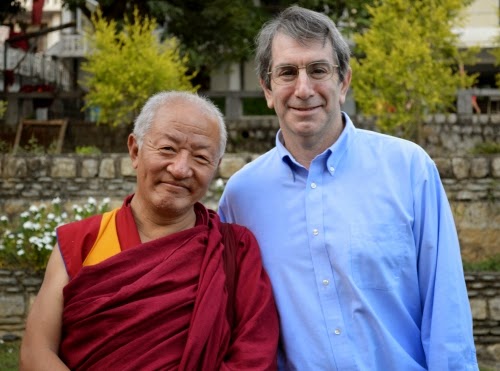
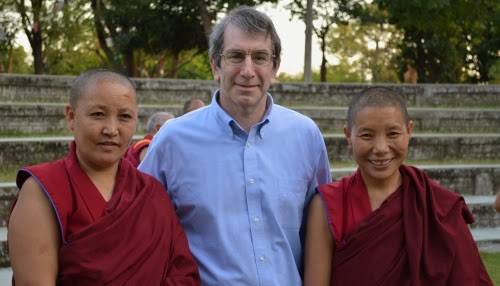
That afternoon, we all gathered outside for photos...lots of photos.

Subscribe to:
Posts (Atom)