Tuesday, April 8, 2025

Day 1

I got an early start to the day after going to sleep at 8:30 pm and waking up at 3 am.  My early wake time allowed me to prepare for the first day of teaching.  The center here is stocked with some basic supplies for me to use, but sometimes I have to improvise with what is available.

First period started at 9 am.  As the 30 nuns filed into the classroom, they seemed eager to learn.  I started with a brief introduction of my background and area of research expertise. Then we moved on to a game of snowball where I asked the nuns to write one fact about the brain on a piece of paper.  The nuns then crumbled up the paper into a ball and attempted to throw it into a small basket I place at the front of the room.  Then then nuns had to find a paper and its owner and discuss the fact on the paper.  We repeated the exercise with the question, "What do you want to know about the brain?"

The responses give me a chance to learn with the nuns already know about the brain and I can change the way I teach. The responses during the snowball game were surprising to me for a few reasons.  First, their responses were more advanced that previous groups of monastics I have taught.  Second, none of the nuns asked about consciousness.  Consciousness is usually the most frequent question the monastics asked about.

After a break for tea, we returned to class to discuss the history of neuroscience.  We started with trephining of skulls, the Edwin Smith Surgical Papyrus and Galen and then made our way to Galvani, Volta, Golgi, Cajal, Loewi, and Huxley.  We even briefly talked about brain imaging, neurotechnology and optogenetics!

This group of nuns is one of the most knowledgeable monastic groups I have taught.  It is likely that they will teach me too. 


Monday, April 7, 2025

Bag O' Coins


The airport in Delhi has much in common with the streets of Delhi.  Many people going from place to place with some rules that I do not understand.  The lines are long and there is much time waiting.  Airport security is a good example.  While waiting to pass through security, I watched as people walked through a metal detector.  Everyone set off the metal detector.  It did not matter if they emptied their pockets, took off their shoes and belt, and placed everything in a bin, the metal detector was set off.  This required an additional screening with the metal detector wand for extra screening.

Coins

Carry on luggage also had rules I did not understand.  In addition to the usual rules about laptops out of bags, most bags received additional “personalized” hand inspection.  This resulted in the contents of bags to be spilled into bins for extra inspection.  As I gathered my things and placed them back into my backpack, I noticed a bag of coins in a bin next to me.  There was no one around to claim the bag so I brought it over to a security officer.  Perhaps the owner of the coins returned later to claim the bag.

It may take extra time for this extra scrutiny, and I hope it keeps the skies above safe.

Organized Chaos

Although I spent only a brief time in Delhi on the way to Dharamsala, I experienced a sense of organized chaos on the streets and in traffic.  Cars seem to go in all directions dodging other cars, motorcycles, people, dogs and cows.  I do not understand the rules of the road because vehicles and animals seem to go anywhere they please. Yet, even as cars pass only inches apart and horns blare nonstop, everyone seems to be very calm and people (and animals) appear to get where they need to go.


Sunday, April 6, 2025

Another Long Journey

Although I know the flight from Seattle to Delhi is long, I haven't found a great way to reduce the toll on my body.  Perhaps if I fly business class?  But it is difficult to justify the much higher cost of business class.

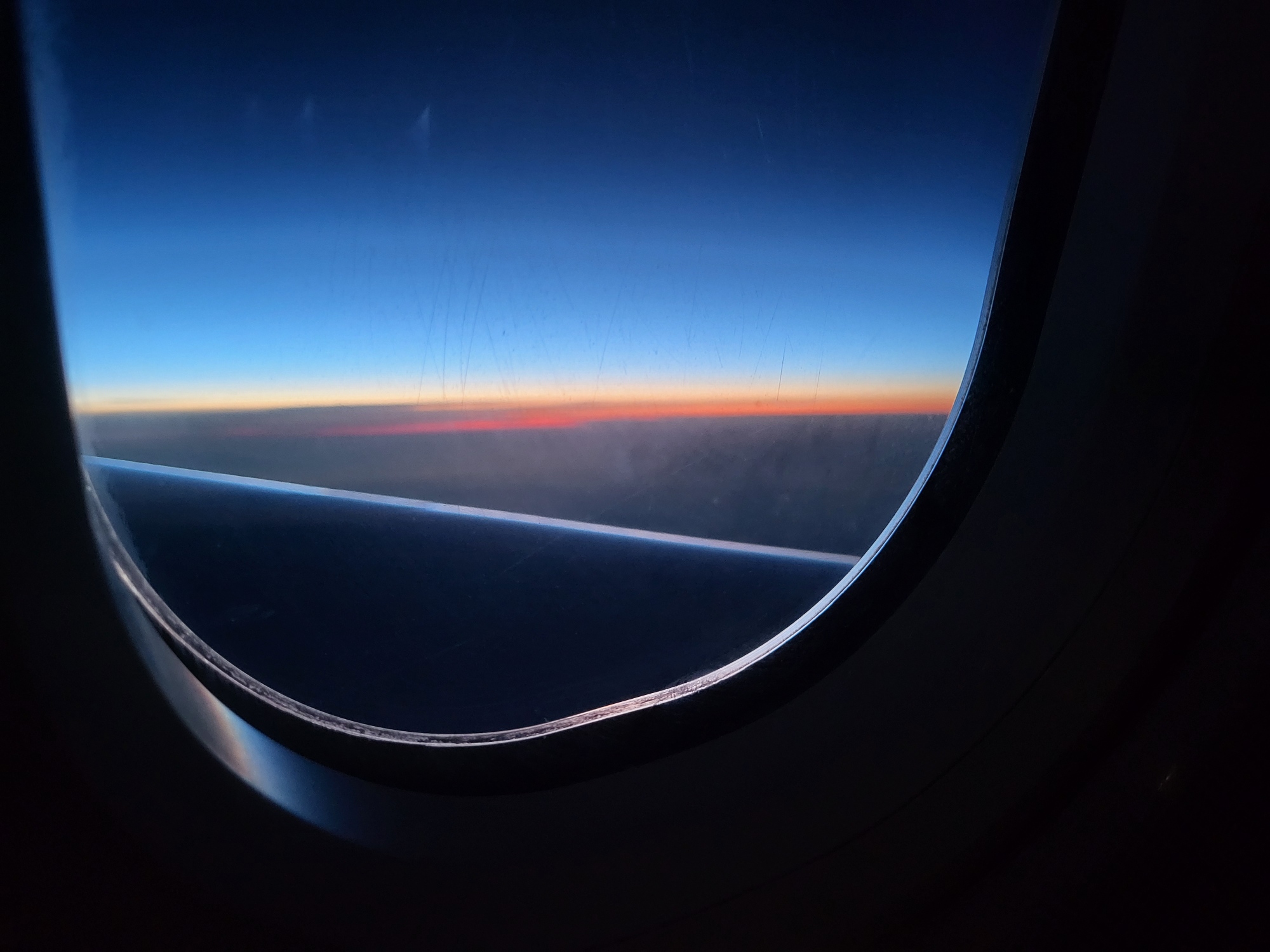
Sunrise from plane window
Sunrise over Greenland
This time it has taken me about 27 hours to get from Seattle to Delhi.  An hour was added to the trip by a delay in the departure of the flight from Frankfurt.  Apparently, the plane took more time than expected to clean.  Seats on airplanes seems to be getting smaller too.  I don't remember feeling as cramped and confined as I did on these flights.

Arrival at 2:30 am at the Delhi airport took a long time too. An ETA/e-visa is supposed to speed things along, but I still had to wait 45 minutes to get through immigration.

But all is well.  I have a brief, relaxing stay at an airport hotel and then it is back to the airport for a 1 hr. 20-minute flight from Delhi to Dharamsala.

Temperatures in Delhi are expected to reach 102-106 degrees F today.


Saturday, April 5, 2025

Time to Travel


It's always tricky to know how much time it will take to get to the airport, check in, go through security and find a departure gate. The start of my journey to India has gone remarkably smooth: 45 min car ride to the airport,  3 minutes to check in at the airline desk, 3 minutes through security using tsa pre, a 5 minutes to find the departure gate.  

Let's hope everything else goes so well.


Thursday, April 3, 2025

New Technology Ahead

There is a bit of new travel technology in store for me on this trip.  First, to enter the airport terminal in Delhi, travelers must now show a QR code to enter.  In the past, a boarding pass was required to enter.  My airline sent me the QR code that can be printed or downloaded to my phone.

Second, the Delhi airport is now using an expedited biometrics process during the immigration process. A person with an Electronic Travel Authorizations (ETA), which I have, can use an Automated Biometric Kiosk Machine at pre-immigration areas.  This is supposed to reduce the time it takes to go through immigrations.  We'll see!  


Monday, February 24, 2025

ETA / e-VISA

Getting a visa to enter India is not as difficult as it once was.  Several years ago, people had to send their passport in the mail with an application and photos to a consulate. The process now is much easier:  travelers can apply for electronic travel authorization (ETA) online.  The ETA form requires information about a traveler's trip, some personal information and a scan of the traveler's passport and photograph.  And, of course, a fee ($40 for a one-year visa).  The ETA must be presented on entry to India and then a visa is stamped in the passport. 

The whole process was relatively fast too: it took only 48 hours between the time I entered my information on the e-VISA portal and when I received notice that the ETA was granted.  This is much faster than the old days when it would take several weeks to send off a passport through the mail and wait for it to be returned.